

Selling and Buying in California: 2026 Strategy Guide

What if the biggest risk in your next move isn't the market's volatility, but the fear of being "homeless" between closings? In a state where the median home price reached $904,640 this year, the stakes for selling and buying at the same time California are incredibly high. You're likely feeling the weight of coordinating two massive transactions while worrying about the logistical nightmare of a double move.
It's a valid concern; the 2026 market demands more than just luck, it requires a calculated sequence.
We're here to replace that anxiety with a clear roadmap designed to protect your hard-earned equity. You'll learn how to master the "buy-sell dance" by leveraging modern bridge tools and the latest C.A.R. contract protections. This guide explores how to utilize Proposition 19 tax benefits, navigate current inventory trends, and use updated disclosure forms to ensure you transition seamlessly from one front door to the next without ever needing a temporary rental.
Key Takeaways
- Evaluate the pros and cons of "Buy First" versus "Sell First" strategies to determine the most secure path for selling and buying at the same time California.
- Learn how to use specialized C.A.R. forms, such as the COP and SPRP, to create a legal safety net that prevents double moves.
- Discover how bridge loans and HELOCs can unlock your current equity to fund a down payment before your current home even hits the market.
- Gain a competitive advantage in the South Bay by leveraging off-market listings and a synchronized transaction calendar to time your move perfectly.
- Understand how Proposition 19 can protect your finances by allowing you to transfer your existing property tax basis to a new primary residence.
Table of Contents
- The Buy-Sell Dilemma: Understanding the California Market in 2026
- Strategic Options: Should You Buy First or Sell First?
- The California Contingency Safety Net: C.A.R. Forms Explained
- Financing the Transition: Bridge Loans, HELOCs, and Prop 19
- The Bhagat Group Roadmap: A Frictionless Move in the South Bay
The Buy-Sell Dilemma: Understanding the California Market in 2026
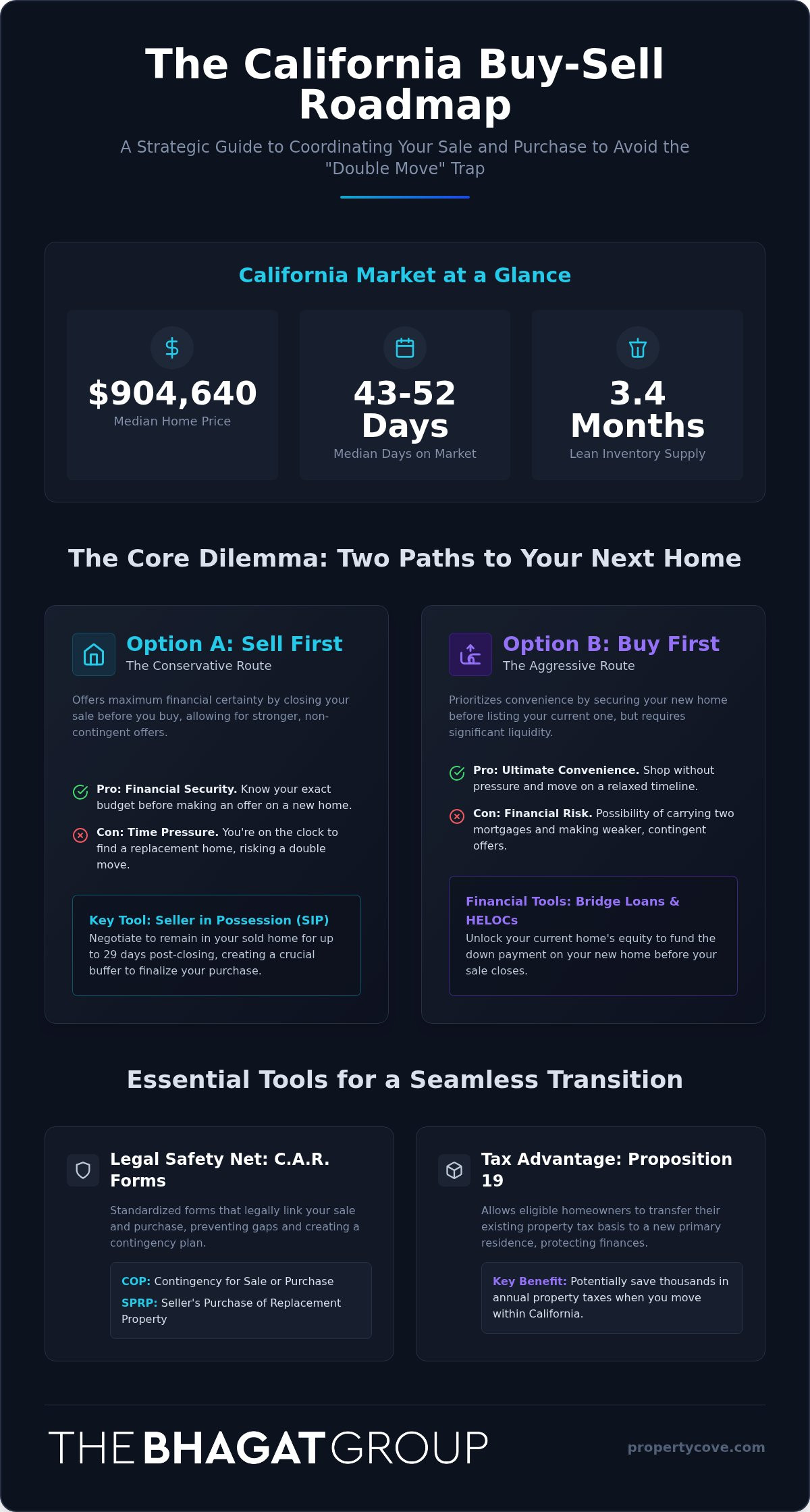
A simultaneous transaction is the standard for California homeowners looking to upgrade. It involves closing the sale of your current home and the purchase of your next one within days, or even hours, of each other. Managing the logistics of selling and buying at the same time California requires a deep understanding of local inventory and contract law. While this move protects your equity, it often leads to the "Double Move" trap.
This is the expensive and exhausting reality of moving into temporary housing because your timelines didn't align. Avoiding this requires "Strategic Sequencing," a process that aligns your sale and purchase through precise contract dates rather than luck. It's about ensuring you never have to pay for a storage unit or a short-term rental while you wait for a key.
Why California Transactions Are Unique
The South Bay market moves with a speed that can catch unprepared buyers off guard. With a median days on market hovering around 43 to 52 days in mid-2026, your buy-side offer must be ready to go the moment your current home is under contract. Understanding the economic principles of real estate helps explain why our local inventory remains at a lean 3.4 months of supply. Unlike "attorney states" on the East Coast, California relies on neutral escrow companies to manage the transition.
This means your success depends on the standardized C.A.R. (California Association of Realtors) forms that dictate exactly when and how your funds move. National headlines might suggest inventory is rising, but in the South Bay, the demand for quality single-family homes remains high, keeping the pressure on for those trying to time two closings.
Assessing Your Equity and Buying Power
Before you look at new listings, you must establish a clear financial baseline. Using an instant property valuation allows you to estimate your net proceeds after closing costs. This number is vital for calculating your "bridge capacity," which is the amount of equity you can tap into for a down payment before your current sale officially closes.
When you're selling and buying at the same time California, your equity is your greatest leverage, but it's also your biggest liability if not handled with precision. It's a 60-day sprint that requires both financial and emotional readiness. Are you prepared to manage showings while simultaneously hunting for your next front door? Knowing your numbers early removes the friction from these high-stakes decisions and helps you set a realistic budget for your next chapter.
Strategic Options: Should You Buy First or Sell First?
Deciding whether to list your current residence or hunt for a new one first is the central pivot point of your journey. While national platforms often claim selling first is the only safe route, the reality of selling and buying at the same time California is more nuanced. You're balancing financial safety against the very real risk of being priced out of your preferred neighborhood while you wait for a closing. The goal for most is the "Simultaneous Close," which allows for a single move.
Concurrent Closing is the alignment of two escrow periods to end on the same day.
Option A: Selling First (The Conservative Route)
This path offers the highest level of financial certainty. By closing your sale first, you know exactly what your net proceeds are, which allows you to make stronger, non-contingent offers on your next home. However, it often comes with logistical pressure. If you don't find a replacement home immediately, you might face a double move. To mitigate this, we often negotiate a "Seller in Possession" (SIP) agreement using standard California Association of REALTORS® (C.A.R.) forms.
This allows you to remain in your home for up to 29 days after closing, giving you a vital buffer to finalize your purchase. This strategy is ideal in a cooling market where homes take longer to sell and you want to ensure your cash is in hand before committing to a new mortgage.
Option B: Buying First (The Aggressive Route)
Buying first is the ultimate convenience, but it requires significant liquidity or specialized financing. You can shop without the pressure of a ticking clock, ensuring you don't settle for a home that doesn't meet your needs. The downside is the risk of carrying two mortgages simultaneously if your first home doesn't sell as quickly as expected. It's also harder to get offers accepted in a competitive market if they are contingent on a sale.
This route is best when you've discovered one of our exclusive featured listings that simply won't stay on the market long enough for you to list your own home first. It allows for a relaxed move-in timeline, but it demands a robust financial strategy to manage the transition period.
Success in selling and buying at the same time California often starts with a clear picture of your current home's worth. Before committing to a strategy, you can get a preliminary property valuation to see how much equity you have to work with. Whether you choose the conservative or aggressive route, your choice should reflect both your financial "bridge capacity" and your comfort with the timeline ahead.
The California Contingency Safety Net: C.A.R. Forms Explained
The legal framework in our state is designed to ensure you aren't forced into a sale that leaves you without a roof over your head. When you're selling and buying at the same time California, specialized forms from the California Association of Realtors act as essential "circuit breakers." These documents protect your earnest money deposit and provide a clear "Right to Cancel" if your synchronized timeline falls apart.
By using these protections, you ensure that if one transaction fails to close, you aren't legally bound to complete the other under impossible conditions. It's the ultimate safety net for your equity and your peace of mind.
Step 1: The COP Contingency (Buying Side)
When you find your next home, your offer will likely include the "Sale of Buyer’s Property" (COP) contingency. This tells the seller that your ability to purchase their home depends on your current residence going under contract or successfully closing. In the competitive South Bay market, we typically see contingency periods of 17 or 21 days, though these are always negotiable based on the strength of your position. Be prepared for a "72-hour kick-out clause" in a hot market like Torrance.
This provision allows the seller to keep their home on the market and, if they receive a better offer, gives you just three days to either remove your contingency or step aside. It sounds intense, but it's a manageable part of the dance when you have a clear plan in place.
Step 2: The SPRP Contingency (Selling Side)
On the selling side, the "Seller’s Purchase of Replacement Property" (SPRP) contingency is your most powerful tool. It informs your buyer that the sale of your current home is only final if you find and secure your next residence within a specific "Finding Period." This window is usually between 15 and 45 days. Finding a buyer who is willing to wait is a specific skill; we often target first-time buyers with flexible leases or investors who don't have a strict move-in date.
Managing the expectations of both parties is vital when selling and buying at the same time California. By setting realistic deadlines and using the most recent June 2026 contract updates, you create a buffer that prevents the stress of a double move before your new front door is ready for you.
Financing the Transition: Bridge Loans, HELOCs, and Prop 19
Financing is the critical engine that powers the process of selling and buying at the same time California. Without a strategic plan for your capital, your equity remains locked in your current walls just when you need it most. Bridge loans are a popular solution for this exact scenario. These short-term loans currently feature interest rates between 8% and 11%, allowing you to use your current equity to fund a new down payment.
While they offer immediate liquidity, expect lender fees around 2.75 points on your departing residence and 2 points on the new property.
A HELOC strategy offers another path for homeowners who want to act quickly. By drawing a line of credit on your current home before it hits the market, you can access cash at rates averaging around 7.29% as of September 2026. If these traditional routes don't fit, some buyers utilize 401(k) loans or gift funds for temporary liquidity to secure a new home without a sale contingency. Prop 19 allows California homeowners over 55 to transfer their low property tax basis to a new primary residence.
Leveraging Your Current Equity
Lenders typically require you to be pre-approved for the "worst-case scenario," which means proving you can carry both mortgages if your current home stays on the market longer than the median 43 to 52 days. To make this more affordable long-term, many buyers use the "Recasting" trick. Once your original home sells, you apply the large cash proceeds to your new mortgage and ask the lender to recast the loan. This lowers your monthly payment without the high costs of a full refinance.
Proving your equity to a lender starts with an accurate assessment of your home's current market value. Use our instant property valuation tool to document your equity and strengthen your financial position before applying for transition financing.
Prop 19 and Tax Portability
Prop 19 is a massive financial incentive for those selling and buying at the same time California, especially in high-value areas like the South Bay. It allows qualifying residents, including those over 55 or victims of natural disasters, to keep their current tax assessment when moving to a new home of any value. This can save you thousands in annual property taxes if you've owned your current home for a long time. The rules are now simplified, allowing for "Intercounty" transfers anywhere in the state.
Note that for parent-to-child transfers, an inflation-adjusted exclusion limit of $1,044,586 applies through February 15, 2027. Additionally, a voter-led initiative on the November 2026 ballot may further impact these rules, making it vital to consult with a local expert on your specific move.
The Bhagat Group Roadmap: A Frictionless Move in the South Bay
Rahul and Surbhi Bhagat understand that selling and buying at the same time California isn't just a financial transaction; it's a massive life transition. To manage the friction of dual escrows, we utilize a master transaction calendar that synchronizes every contingency removal and closing date. This meticulous planning ensures that your sale proceeds are ready exactly when your purchase requires them.
We also provide an "Off-Market" advantage through our featured property listings, allowing you to find your next home before it faces the intense competition of the open market.
Our team excels at making contingent offers look as strong as cash. We do this by presenting a fully vetted file on your current home's sale status to the seller's agent, removing the uncertainty that often plagues these deals. Beyond the paperwork, our relocation support coordinates the essential logistics, from professional cleaners to vetted movers, aiming for a one-day transition from your old front door to the new one.
We don't just list homes; we manage the entire "buy-sell dance" so you don't have to.
Local Expertise in Torrance and Beyond
Deep roots in Torrance and the South Bay allow us to target the right buyer profile for your specific neighborhood. Whether it's the family-friendly vibe of West Torrance or the coastal appeal of the Hollywood Riviera, we know how to position your home to attract buyers with flexible timelines. While we don't provide mortgage lending ourselves, we connect you with a network of local lenders who specialize in California bridge products.
This local synergy was the key to a recent success story where we managed a 30-day simultaneous close for a family moving within Torrance, ensuring they never had to spend a single night in a hotel.
Your Next Steps to a Seamless Transition
Ready to take the first step? Follow this simple roadmap to start your transition with confidence:
- Step 1: Get your Instant Property Valuation to see your numbers.
- Step 2: Schedule a "Strategy Session" with Rahul and Surbhi to map out your specific sequencing.
- Step 3: Begin your "Featured Property Search" to see what is available in our exclusive inventory.
Ready to move? Contact The Bhagat Group today for a customized relocation plan.
Your Seamless Transition Starts Here
Mastering the logistics of selling and buying at the same time California doesn't have to be a source of constant anxiety. By aligning your timelines through a master transaction calendar and utilizing the protective "circuit breakers" found in standard C.A.R. forms, you can move directly from one front door to the next.
Whether you're leveraging Prop 19 tax benefits to preserve your tax basis or tapping into equity via a bridge loan, the right strategy ensures your wealth stays protected and your move remains frictionless. These tools exist to turn a high-stakes transition into a manageable, step-by-step process.
Rahul and Surbhi Bhagat specialize in these complex South Bay simultaneous transactions. Backed by the professional resources of eXp Realty of California, they provide the expert local guidance needed to navigate the unique rhythms of the 2026 market with absolute confidence. You don't have to face the "buy-sell dance" alone. Start Your Move with a Free Strategy Session today to map out your custom roadmap and secure your next home at fair market value.
Your next chapter in the South Bay is closer than you think, and we're here to lead the way.
Frequently Asked Questions
Can I Buy a Home in California Contingent on Selling Mine?
Yes, you can submit a contingent offer using the C.A.R. "Sale of Buyer’s Property" (COP) form. This is a standard strategy for move-up buyers in Torrance who need their current equity to fund the next purchase. While sellers in a competitive market might prefer non-contingent offers, a well-structured COP showing your home is already in escrow can be very persuasive. It ensures you aren't legally obligated to buy unless your current home successfully closes.
What Is a "Rent-Back" Agreement and How Does It Help With Timing?
A "Rent-Back" agreement, officially known as a Seller in Possession (SIP) form, allows you to remain in your home after the sale officially closes. In the South Bay, this is often negotiated for up to 29 days to provide a vital buffer for your new purchase to finalize. It’s a vital tool for selling and buying at the same time California because it eliminates the need for temporary housing or a double move, allowing for a single transition.
How Does Prop 19 Affect My Property Taxes if I Buy a More Expensive Home?
Prop 19 allows qualifying homeowners over 55 to transfer their original property tax basis to a more expensive primary residence anywhere in California. If your new home costs more than your old one, the difference in market value is simply added to your transferred tax basis. This prevents a massive jump in annual taxes, making it much more affordable for long-term South Bay residents to upgrade or downsize without losing their historical tax protections.
What Happens if My Home Sale Falls Through While I Am in Escrow on a New One?
If your home sale falls through while you are in escrow on a new one, your "Sale of Buyer’s Property" contingency acts as a legal safety net. Because your purchase is contingent on the sale of your current residence, you typically have the right to cancel the purchase contract without losing your earnest money deposit. This protection is why working with a local expert who understands the nuances of C.A.R. contract timelines is essential for your security.
Is a Bridge Loan Expensive in California?
Bridge loans in California are specialized short-term products with interest rates currently ranging from 8% to 11%. You should also expect lender fees of approximately 2.75 points on your departing home and 2 points on the new property. While more expensive than traditional 30-year mortgages, they provide the necessary liquidity to make non-contingent offers. This can be a decisive advantage when selling and buying at the same time California in high-demand neighborhoods like West Torrance.
How Long Does a Simultaneous Closing Typically Take in the South Bay?
A simultaneous closing in the South Bay typically takes between 30 and 45 days once both properties are under contract. This timeline aligns with the local median of 43 to 52 days on market seen in mid-2026. Success depends on the synchronized management of two separate escrow periods. The Bhagat Group uses a master transaction calendar to ensure that inspections, appraisals, and loan fundings for both homes happen in the precise order required for a same-day move.
What Is a "Kick-Out" Clause in a Real Estate Contract?
A "Kick-Out" clause, often found in the COP form, allows a seller to keep their home on the market while waiting for your contingency to be met. If the seller receives a better, non-contingent offer, they can give you a "72-hour notice" to either remove your sale contingency or cancel the contract. This clause balances the risk for the seller while still giving you the first right of refusal to move forward with the purchase if you have the funds.
Do I Need Two Different Agents for the Sale and the Purchase?
You don't need two different agents, and using one team is actually highly recommended for better coordination. When the same professional manages both your sale and your purchase, they have a bird's-eye view of both timelines. This centralized communication prevents the "Double Move" trap and ensures that negotiations on one side don't accidentally sabotage the other. The Bhagat Group specializes in this dual representation to provide a frictionless experience for families in Torrance.