

Negotiating Home Price in California: The 2026 Buyer’s Strategy Guide

What if the number you write on your initial offer isn't actually the final price you pay at closing? In a market where the median home price has reached $905,000, it's easy to feel like you're at the mercy of the seller. You've likely felt that familiar sting of anxiety, worrying that you'll either overpay or lose your dream home because you didn't understand the nuances of negotiating home price in California.
It's a stressful balancing act, especially when state-specific contracts and fast-moving local trends seem designed to confuse even the most prepared buyers.
We understand that frustration, and we're here to help you regain control. This guide provides a clear roadmap for making competitive bids that protect your interests while ensuring you don't miss out in a crowded market. You'll discover how to leverage 2026 market data, such as the projected 10% increase in active listings, to your advantage. We'll also explore how to use the inspection phase as a critical second negotiation point to adjust your final investment.
By the end of this article, you'll have the confidence to partner with a local expert and secure a home at a price that makes sense for your long-term goals.
Key Takeaways
- Learn why California's "as-is" contract clause is actually an invitation for negotiation rather than a final word on the property's condition.
- Master the art of negotiating home price in California by utilizing hyper-local comparable sales and value-per-feature analysis to justify your offer.
- Discover how non-monetary terms, such as strategic rent-back agreements, can make your bid more attractive than higher-priced offers.
- Understand the tactical differences between requesting repairs and requesting credits to maximize your savings during the inspection period.
- Gain a distinct advantage in the South Bay market by uncovering neighborhood-specific tactics and the benefits of off-market pocket listings.
Table of Contents
- Understanding the California Real Estate Landscape in 2026
- Data-Driven Negotiation: How to Value a California Home
- Mastering the Offer Strategy: Beyond the Sales Price
- The Second Negotiation: Credits and Repairs After Inspection
- Navigating High-Stakes Negotiations in Torrance and South Bay
Understanding the California Real Estate Landscape in 2026
Success in the Golden State's property market starts with understanding the local rules of engagement. Negotiating home price in California isn't just about the final dollar amount; it's about the framework provided by the California Association of Realtors (CAR). Most transactions rely on the Residential Purchase Agreement (RPA), a comprehensive document that dictates how offers are made, accepted, and amended.
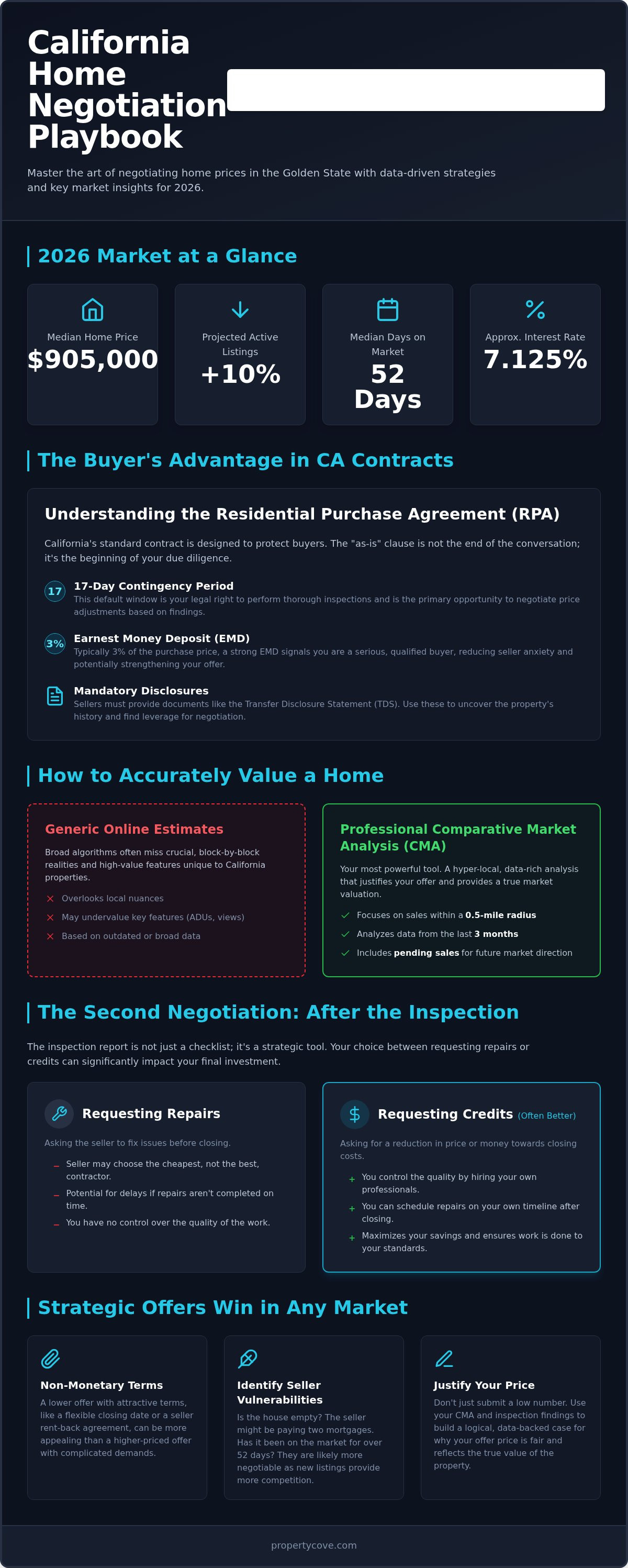
Unlike other states where "as-is" might mean you're buying a mystery box, California's standard contract includes a default 17-day contingency period. This window allows you to investigate the property's condition thoroughly, and it's your primary window for price adjustments.
The Legal Framework of California Offers
The RPA is the script for your transaction. Within this document, your Earnest Money Deposit (EMD), usually around 3% of the purchase price, serves as your initial show of good faith. It's a vital part of the art of negotiation because it signals to the seller that you're a serious, qualified buyer. California's strict disclosure laws also work in your favor. Sellers are legally required to provide a Transfer Disclosure Statement (TDS) and a Seller Property Questionnaire (SPQ).
These documents often reveal the "why" behind a seller's pricing, giving you the psychological edge needed to propose a fair reduction if the home's history doesn't match its list price.
- RPA Default Terms: Standard contracts favor buyer investigation, giving you 17 days to perform inspections.
- EMD Strategy: A higher deposit can sometimes secure a lower purchase price by reducing seller anxiety.
- Disclosure Power: Use the mandatory disclosures to identify potential "red flag" repairs before your contingency period ends.
State-Level Market Trends Affecting Negotiation
Right now, the 2026 market shows a shift toward more balanced conditions. While the median home price in California has reached approximately $905,000, the pace of sales has moderated to a median of 52 days on market. This slower velocity is a gift for buyers. You're no longer forced into a four-hour decision window.
With active listings projected to increase by nearly 10% this year, you have more leverage when negotiating home price in California than you did during the inventory droughts of previous years.
Interest rates, currently hovering around 7.125% for a 30-year fixed mortgage, have changed seller expectations. High-stakes "bidding wars" have largely been replaced by strategic positioning. Sellers are more willing to listen to offers that include "clean" terms or flexible closing dates. If a home has been sitting for more than 40 days, it's a clear signal that the seller may be open to credits or a price reduction to move the process forward.
Data-Driven Negotiation: How to Value a California Home
Algorithms like the "Zestimate" are broad tools, but they often miss the block-by-block reality of Golden State neighborhoods. Negotiating home price in California requires a much sharper instrument. Success depends on distinguishing between a home's price per square foot and its actual value per feature. For instance, a permitted ADU or a high-end kitchen renovation adds specific value that a computer model might undervalue or completely overlook.
You're looking for the ground truth, not a generic estimate.
The Art of the Comparative Market Analysis (CMA)
A professional CMA is your most powerful weapon in any negotiation. To get an accurate picture, we focus on homes sold within a 0.5-mile radius over the last three months. We don't just look at the final sales price; we analyze pending sales data to understand where the market is headed next week, not just where it was last month. We then adjust for high-value California assets like ocean views or solar installations.
If you're curious about how your current home stacks up before you buy your next one, you can get an instant property valuation to see the baseline.
Identifying Seller Vulnerabilities
Numbers tell a story about the person on the other side of the table. With the median days on market currently at 52 days, any listing crossing the two-month mark suggests a seller who might be feeling the pressure. This is especially true as active listings are projected to increase by nearly 10% in 2026, giving buyers more options and making sellers more anxious about competition.
An "empty house" is a major vulnerability; the seller is likely paying two mortgages or losing out on potential investment returns every day the home sits.
Look for probate sales or relocation listings. These sellers often prioritize a certain timeline over squeezing out every last dollar. By recognizing these stale listings or price drop histories, you gain a distinct advantage when negotiating home price in California. You're no longer just making an offer; you're providing a solution to the seller's specific problem. This strategic approach ensures you aren't just guessing, but rather making a calculated move based on the seller's unique situation.
Mastering the Offer Strategy: Beyond the Sales Price
A common mistake is believing that the highest price always wins. In reality, a "clean" offer with fewer hurdles often beats a higher bid that's bogged down by complex demands. Negotiating home price in California effectively means understanding what the seller values most, which is frequently certainty and convenience. If you can remove friction from their transition, they're often willing to accept a slightly lower price in exchange for peace of mind.
You aren't just buying a house; you're helping the seller move on to their next chapter.
One of the most powerful tools in your arsenal is the "Rent Back" agreement, formally known as a Seller License to Remain in Possession. This allows the seller to stay in the home for a short period after closing. For a seller trying to coordinate their own move, this flexibility is worth thousands of dollars. Similarly, shortening the standard 17-day appraisal contingency can build immense trust.
It signals that you're confident in the home's value and won't use a low appraisal as an excuse to back out at the last minute. Escalation clauses can also work, but they must be capped to ensure you don't accidentally overpay in a heat-of-the-moment bidding situation.
Winning Terms That Don’t Cost Extra
You don't always need to spend more to win. Offering a flexible closing date that aligns with the seller's next move can make your offer stand out. You might also consider increasing your Earnest Money Deposit (EMD) beyond the typical 3% to demonstrate your commitment. While you should never waive major safety or structural contingencies, waiving minor ones, such as the right to request cosmetic repairs, can make your bid look much more attractive to a seller who wants a "hassle-free" sale.
Financial Positioning and Credibility
Your financial "passport" matters just as much as your offer price. A Desktop Underwritten (DU) approval is far superior to a standard pre-approval because it means an automated system has already vetted your credit and income data. When negotiating home price in California, presenting this along with clear proof of funds for your down payment removes doubt. Sellers also pay close attention to your lender.
A local lender with a reputation for closing on time carries more weight than a faceless online bank, as it suggests the deal won't fall apart in the final days.
Lastly, be cautious with "Personal Letters." While a heartfelt note once helped, California fair housing guidelines have made many listing agents wary of presenting them to avoid bias. Focus instead on the strength of your terms and the reliability of your financing to tell the story of why you're the right buyer. This professional, data-backed approach builds a bridge of trust that emotional pleas simply can't match.
The Second Negotiation: Credits and Repairs After Inspection
Securing a signed contract is only half the battle. Once you move into the investigation phase, the data from your General Home, Pest, and Sewer lateral inspections becomes your new bargaining chips. Negotiating home price in California often shifts from market value to "cost to cure" during this window. If a roof is at the end of its life or the sewer line is cracked, those are tangible expenses that weren't visible when you made your initial offer.
You're no longer arguing about what the home is worth; you're discussing the cost to make it safe and functional.
Focus your energy on the "Big Three": the roof, the foundation, and the electrical or plumbing systems. These are the high-stakes items that lenders and insurers care about most. Instead of guessing at the costs, bring in a licensed professional to provide a written estimate. A formal contractor’s quote acts as a powerful negotiation weapon; it moves the conversation from your opinion to a professional's documented reality.
Sellers find it much harder to argue with a line-item estimate from a local expert than a vague request for a discount.
The Request for Repair (RR) Process
The California Request for Repair (RR) form is your formal tool for this stage. While you can ask the seller to fix things, we usually recommend a Request for Credit (RC) instead. Sellers often look for the cheapest, fastest way to complete a repair to close the deal. By taking a closing cost credit, you control the quality of the work after you move in. If the seller issues a "take it or leave it" response, your leverage depends on how long the home was on the market before you arrived.
If you're ready to start this process with a team that knows how to push for these credits, explore our Home Buyer Representation services.
Calculating the Value of a Credit
In the 2026 California labor market, repair costs have remained high due to specialized trade shortages. When calculating a credit, ensure it covers the full scope of the work plus a small buffer for unforeseen issues. Be mindful of lender limits; most banks won't allow seller credits to exceed your total closing costs. You can apply these credits toward "non-recurring" costs like title fees or "recurring" costs like pre-paid property taxes.
This effectively reduces the amount of cash you need to bring to the closing table, making the home more affordable without changing the loan amount. This strategic shift allows you to keep your liquid savings intact for future renovations while still "winning" the price negotiation.
Navigating High-Stakes Negotiations in Torrance and South Bay
While broader state trends provide a necessary baseline, the real work of negotiating home price in California happens at the neighborhood level. In the South Bay, market dynamics can shift from one block to the next. A strategy that works for a mid-century home in West Torrance might fail completely for a coastal property in South Redondo. Sellers in these high-demand enclaves are often sophisticated and well-represented, meaning your approach must be equally polished and data-driven to stand out.
Success often depends on the "hidden" market. Pocket listings, or off-market opportunities, allow you to negotiate without the pressure of a public bidding war. This is where a local agent's reputation becomes your greatest asset. When listing agents know they're working with a professional who has a track record of seamless transitions and reliable closings, they're more likely to encourage their sellers to accept your offer, even if it isn't the highest on paper.
Trust is a currency that can often buy you a better price.
Local Market Nuances in the South Bay
In West Torrance, the primary driver is the Torrance Unified School District. Competition here remains steady because families prioritize these specific boundary lines. Negotiation in this area often requires speed and "clean" terms with minimal contingencies. Conversely, in South Redondo, we pay closer attention to coastal geological concerns and the influence of local tech and aerospace cycles. With major employers nearby, the housing market often mirrors the hiring phases of the aerospace corridor.
Understanding these hyper-local rhythms allows us to time your offer for maximum leverage when negotiating home price in California.
- West Torrance: Focus on school district proximity and lot size as primary value drivers.
- South Redondo: Prioritize geological inspections and coastal maintenance history during the "second negotiation."
- Aerospace Influence: Monitor local industry shifts to predict when seller motivation might be highest.
The Bhagat Group Advantage
Led by Rahul and Surbhi Bhagat, our team acts as your "Authoritative Partner" throughout the entire process. We don't just find houses; we provide comprehensive Home Buyer Representation that removes the friction from high-stakes deals. Our process-driven approach ensures that every step, from the initial search to the final Request for Repair, is handled with precision and transparency.
You gain access to our Featured Property Listings and deep-rooted community connections, giving you a distinct advantage in a market where the best deals are often found before they ever hit the MLS.
We focus on long-term relationships rather than one-off transactions. By providing meticulous service and expert negotiation prowess, we ensure your journey to homeownership in the South Bay is both successful and calm. Whether you're a first-time buyer or a seasoned investor, our local expertise and tech-savvy strategies provide the stability you need to win in 2026's competitive landscape.
Secure Your Future in the South Bay Market
Success in the 2026 market depends on seeing the big picture. You've learned that winning isn't just about the initial bid; it's about leveraging the inspection period for strategic credits and understanding the hyper-local nuances of neighborhoods like West Torrance. By focusing on "clean" terms and specific seller motivations, you move from being just another offer to becoming the seller's best solution.
Mastering the intricate process of negotiating home price in California requires a blend of data-driven valuation and the kind of high-stakes negotiation prowess that only comes with deep local experience.
Ready to find your place in this vibrant community? Start Your South Bay Home Search with The Bhagat Group today. We combine expert local knowledge of Torrance and the South Bay with a supportive, neighborly approach to ensure your transition is seamless and stress-free. You don't have to navigate this high-stakes journey alone. With a dedicated partner by your side, you can move forward with absolute confidence and secure a home that perfectly fits your lifestyle and your budget.
Frequently Asked Questions
Is It Possible to Negotiate Home Prices in a Seller’s Market in California?
Yes, negotiating home price in California is possible even in a seller's market by leveraging specific seller needs. While prices remain high, the projected 10% increase in active listings for 2026 gives buyers more room to breathe. You can negotiate on non-monetary terms like flexible closing dates or rent-back agreements. These "clean" offers often convince a seller to accept a price below their original asking amount to ensure a smooth, certain, and frictionless transition.
What Is a Reasonable Counter-Offer to Make on a House in Torrance?
A reasonable counter-offer in Torrance depends heavily on hyper-local comparable sales from the last three months. If a home has exceeded the median 52 days on market, a counter-offer of 2% to 5% below asking may be appropriate. However, in top-tier school districts, you might need to stay closer to the list price while negotiating for credits. We always use a detailed market analysis to ensure your offer is both competitive and fair.
How Much Can I Ask for in Repairs After a Home Inspection?
There is no set limit, but you should prioritize health, safety, and structural issues like the roof or foundation. Instead of asking for a specific dollar amount, we recommend providing a licensed contractor's written estimate to justify a Request for Credit (RC). This data-driven approach is more effective than a vague request. In the 2026 South Bay market, sellers are often more willing to provide a closing cost credit than to manage repairs themselves.
What Contingencies Should I Never Waive When Buying a California Home?
You should rarely waive your inspection or appraisal contingencies in the South Bay. The inspection contingency protects you from "cost to cure" issues like cracked sewer laterals or foundation problems. The appraisal contingency ensures you aren't forced to cover a massive "valuation gap" if the bank's estimate falls short of the purchase price. Keeping these protections in place provides the stability needed to navigate high-stakes negotiations without risking your earnest money deposit.
How Do I Know If a Home Is Overpriced for the Current South Bay Market?
Look beyond the list price by analyzing the price per feature rather than just the price per square foot. If a home in South Redondo lacks the upgrades or ocean views of nearby "comps" sold within the last 90 days, it's likely overpriced. We also track the price drop history and total days on market. A listing that has sat for 60 days while neighbors sell in 30 is a clear sign of overpricing.
Can I Negotiate the Real Estate Commission as a Buyer in California?
Yes, real estate commissions are negotiable in California. While the seller often covers these fees, the specific terms are established in the representation agreements signed between clients and their respective agencies. As your Home Buyer Representation team, we focus on transparency regarding how these fees function. Our goal is to ensure you receive expert negotiation prowess and local guidance that far outweighs the cost of professional representation during your South Bay search.
What Happens If the Home Appraisal Comes in Lower Than the Negotiated Price?
A low appraisal triggers a critical negotiation point. You generally have three paths: the seller lowers the price to match the appraisal, you pay the difference in cash, or both parties meet in the middle. If your contract includes an appraisal contingency, you can also walk away with your deposit intact. We use pending sales data to help sellers understand that a lower price is often the only way to keep the deal alive.
How Long Does the Negotiation Process Typically Take in California?
The initial negotiation usually takes one to three days after you submit your offer. However, the entire process of negotiating home price in California spans the length of your contingency period, which is typically 17 days. This timeframe allows for thorough investigations and formal requests for credits. Total time from the first offer to a finalized price agreement usually wraps up within the first three weeks of escrow, ensuring a methodical and well-managed transition.