
Closing Costs for Sellers in Torrance, CA: A Financial Roadmap

Imagine sitting at the closing table in Old Torrance, expecting a certain payout, only to see thousands of dollars vanish into fees you never saw coming. It's common fear for South Bay homeowners, and understanding the closing costs for seller in Torrance CA is the only way to avoid that last-minute sticker shock. Selling your home is a major milestone, but the math behind the final check often feels like a moving target.
You've worked hard to build equity in your property, and it's natural to feel protective of every dollar as you prepare for your next chapter.
This guide will demystify the financial landscape, providing a clear roadmap to 2026's specific tax obligations and escrow customs. You'll learn exactly which fees are set in stone and which ones you can actually negotiate to keep more money in your pocket. We'll break down the Los Angeles County transfer taxes, clarify Southern California escrow splits, and share local strategies to ensure your final net sheet matches your expectations.
Key Takeaways
- Don't get distracted by the gross sale price; instead, focus on your true net proceeds to keep your financial planning accurate.
- Master the specific closing costs for seller in Torrance CA, including the Los Angeles County Documentary Transfer Tax and local escrow customs.
- Understand which costs are negotiable so you're prepared to handle buyer credit requests without sacrificing your hard-earned equity.
- Gain clarity on the "Big Three" expenses of commissions, escrow, and title fees to remove the friction from your final settlement statement.
- See how professional local guidance helps you avoid the common hidden costs that often surprise unrepresented sellers at the finish line.
Table of Contents
- Beyond the Sale Price: Understanding Your Net Proceeds
- The Big Three: Commissions, Escrow, and Title Fees
- Local Taxes and Torrance-Specific Requirements
- Negotiating Closing Costs: Who Pays for What in the South Bay?
- Maximizing Your Equity with Professional Representation
Beyond the Sale Price: Understanding Your Net Proceeds
When you see a high number on a purchase agreement, it's easy to start planning your next purchase or retirement. However, that gross sale price is often a vanity metric. It represents the total value of the transaction, but it doesn't account for the various obligations you must satisfy before you walk away. To truly master your finances, you need to focus on your net proceeds. This is the actual cash you receive once all debts, taxes, and service fees are settled.
In a high-value market like the South Bay, the gap between the sticker price and your final check can be substantial.
Calculating the closing costs for seller in Torrance CA requires looking at the entire timeline of the sale. Some expenses hit your wallet weeks before you list, while others are handled by the escrow officer at the very end. By adopting the mindset of an expert local guide, we prioritize transparency so there are no surprises at the finish line. We don't just want you to sell; we want you to understand exactly how much equity you are protecting during every step of the process.
The Difference Between Upfront and Closing Expenses
Upfront costs include everything needed to make your home market-ready. You might spend $300 to $600 on professional cleaning or $1,000 to $3,000 on staging to ensure your property stands out. These are out-of-pocket investments you pay to service providers before a buyer even walks through the door. Understanding Closing Costs involves distinguishing these initial spends from the fees deducted during escrow.
Closing costs are typically taken directly from your sale proceeds at the end of the transaction. Tracking both categories is the only way to measure your true return on investment and avoid a cash flow crunch during the listing period.
The Role of the Net Sheet in Your Strategy
A net sheet is a detailed document that estimates your final payout. It accounts for your mortgage payoff, property tax prorations, and the specific closing costs for seller in Torrance CA. This document acts as the financial North Star for any South Bay sale. It allows you to make informed decisions about which offers to accept and which negotiation points to push.
Because market fluctuations in Torrance can impact buyer demands and local fees, having a professional net sheet ensures your strategy is based on reality rather than best-case scenarios. We provide these estimates early and update them often so you always know where you stand.
The Big Three: Commissions, Escrow, and Title Fees
Managing the closing costs for seller in Torrance CA requires a clear-eyed look at the three largest expenses on your settlement statement. While every deal is unique, these pillars form the financial foundation of most residential sales in the South Bay. By 2026, market standards have shifted to emphasize transparency, making it easier for you to see exactly where your equity is going.
These fees aren't just administrative burdens; they are the investments that ensure your transaction is legal, funded, and protected.
Brokerage Commissions and Value Exchange
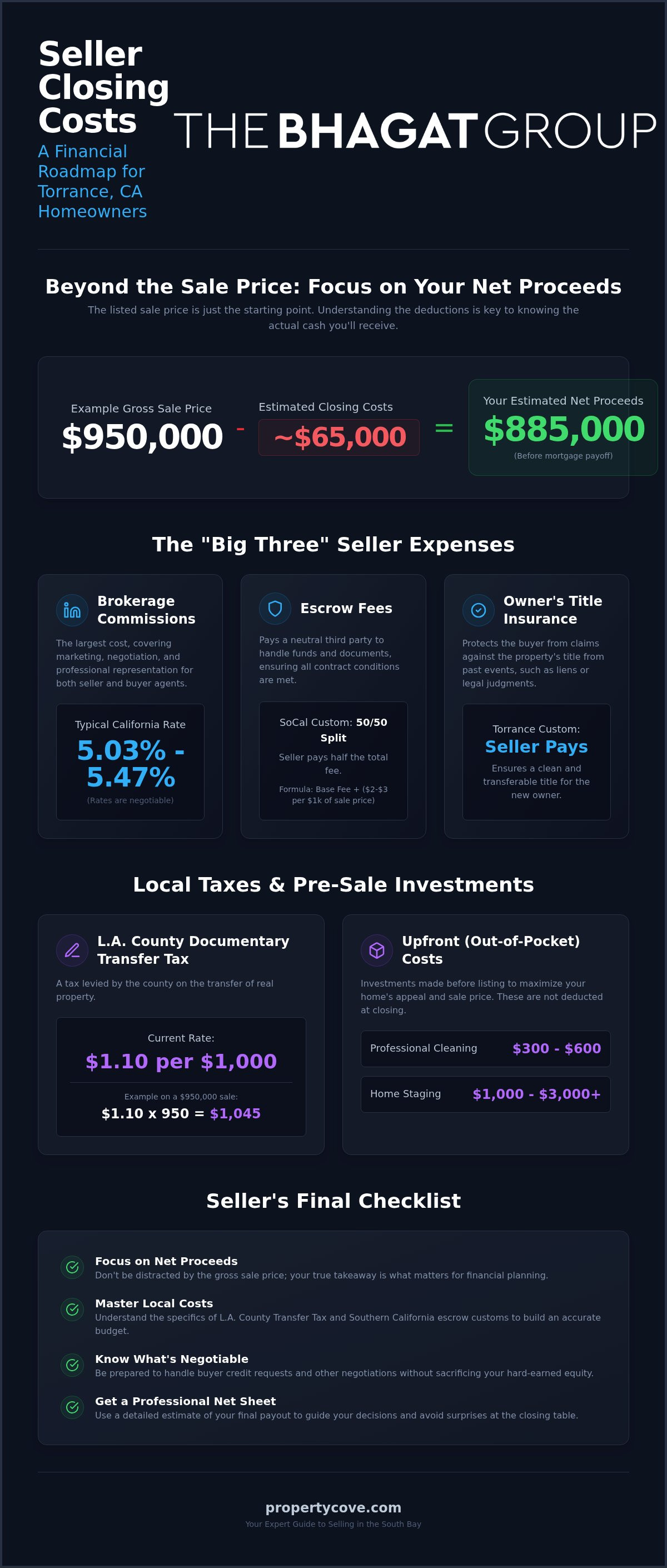
Real estate commissions typically represent the largest portion of your selling expenses. This fee isn't just for a sign in the yard. It covers professional photography, high-end digital marketing, and the high-stakes negotiation required to secure top dollar. In the current 2026 landscape, total commissions in California often range between 5.03% and 5.47%, though these rates are negotiable.
This fee is usually split between the listing agent and the buyer’s agent, ensuring both sides have professional representation. Choosing a "discount" service might seem tempting to save on closing costs for seller in Torrance CA, but it often results in lower exposure and a significantly lower final sale price.
Escrow and Title: The Guardians of the Transaction
Escrow and title fees are the costs of security. In Southern California, it's customary for the seller and buyer to split escrow fees 50/50. You can expect a base fee ranging from $250 to $450, plus an additional $2 to $3 for every $1,000 of the purchase price. For a $900,000 home, your portion might land around $1,075. This pays for a neutral third party to manage the funds and ensure all conditions are met before money changes hands. You'll also need to account for the L.A. County Documentary Transfer Tax, which is currently set at $1.10 per $1,000 of the sale price.
Title insurance is another critical component. In Torrance, the seller traditionally pays for the "Owner's Policy." This protects the buyer against any "clouds" on the title, such as forgotten liens or judgments from previous owners. Ensuring a clean title is a non-negotiable step for a smooth transition. If you're feeling overwhelmed by these moving parts, securing expert Torrance home seller representation is the best way to keep your equity safe.
Having a partner who understands these South Bay customs ensures you never pay more than your fair share at the closing table.
Local Taxes and Torrance-Specific Requirements
While general online calculators give you a rough idea of expenses, they often miss the granular details that define the closing costs for seller in Torrance CA. Selling a home in the South Bay involves a specific set of government fees and municipal mandates that aren't negotiable. These costs are fixed by law or local ordinance, meaning your strategy should focus on accounting for them early rather than trying to negotiate them away at the closing table.
Understanding these line items ensures your net sheet remains accurate from the first day of your listing.
Los Angeles County Documentary Transfer Tax
Every property transfer in the region triggers the Los Angeles County Documentary Transfer Tax. This is a mandatory fee for recording the new deed with the county registrar. The current rate is $1.10 for every $1,000 of the property's sale value. For example, a home sold at $1,000,000 results in a $1,100 tax bill. While buyers and sellers can technically negotiate who pays this, the established custom in Torrance is for the seller to cover the cost.
Transfer taxes are non-negotiable government fees that must be paid to finalize the recording of the sale.
One significant advantage of selling in Torrance is that the city doesn't impose its own additional transfer tax. This distinguishes it from neighbors like Culver City or the City of Los Angeles, where city-specific levies or "mansion taxes" can significantly increase the total bill. Staying within Torrance city limits keeps your tax burden relatively straightforward, though you still need to account for your prorated share of annual property taxes.
These are calculated based on the number of days you owned the home during the current tax installment period.
Mandatory Local Disclosures and Inspections
California law requires every seller to provide a Natural Hazard Disclosure (NHD) report. This document informs the buyer about flood zones, seismic risks, and fire hazards specific to your Torrance neighborhood. Beyond state laws, you must also comply with local municipal codes. Torrance requires sellers to ensure that smoke detectors are properly installed and water heaters are double-strapped for seismic safety before the close of escrow.
These compliance checks are essential for a frictionless transition and are typically verified during the inspection period.
If your home is located within a gated community or a managed complex, you'll also need to budget for HOA transfer fees. These are charged by the association to update their records and provide the buyer with necessary governing documents. Finally, don't forget the South Bay standard: the termite inspection. Most buyers will expect a "Section 1" clearance, which means the seller pays for the treatment of any active infestations.
Addressing these small but vital closing costs for seller in Torrance CA early prevents delays and protects your equity through transparency.
Negotiating Closing Costs: Who Pays for What in the South Bay?
Negotiation is the stage where your net proceeds either stabilize or shrink. While we've discussed the specific closing costs for seller in Torrance CA, it's vital to remember that almost every line item on a California Residential Purchase Agreement is negotiable. Understanding the difference between local tradition and legal obligation gives you the leverage needed to protect your equity.
In 2026, as market dynamics fluctuate, these negotiations often determine how quickly a deal moves from "pending" to "closed".
Standard South Bay Customs
In Torrance, a set of standard customs usually dictates the initial offer. Sellers typically cover the owner's title insurance policy, the county transfer tax, the Natural Hazard Disclosure report, and half of the escrow fees. Buyers generally pick up the tab for their lender's title policy, the other half of escrow, and their own inspections. However, these aren't laws.
During high-inventory periods, we often see sellers offering to pay for items traditionally handled by buyers to make their property more attractive. Conversely, in a competitive seller's market, you might successfully ask a buyer to cover the county transfer tax or a larger share of the escrow costs.
Leveraging Concessions in Negotiations
One of the most effective tools in your arsenal is the seller credit. Instead of lowering your sale price when a buyer discovers a needed repair, you can offer a credit toward their closing costs. This is often more attractive to buyers because it reduces their immediate out-of-pocket cash requirement. For you, a credit is often better than a price reduction because it keeps the "comparable" sale price high for the neighborhood. This supports local property values and protects your long-term investment.
In 2026, credits ranging from 1% to 3% have become common strategic moves to bridge the gap during the inspection period.
Rahul and Surbhi Bhagat specialize in this high-stakes fee management. They don't just accept the standard splits. They analyze the current market temperature to determine when to push back and when to concede. By treating every fee as a negotiation point, they ensure you aren't leaving money on the table. If you want to see how these strategies apply to your specific home, it's time to get a professional property valuation .
This baseline allows us to build a negotiation strategy that keeps your net proceeds as high as possible.
Maximizing Your Equity with Professional Representation
Protecting your equity isn't just about cutting expenses; it's about maximizing the total value of your asset. While the closing costs for seller in Torrance CA might seem like a hurdle, the right partner transforms these fees into a strategic investment. An accurate home valuation serves as the bedrock of your financial plan. Without a precise starting number, your net sheet is just guesswork.
We provide a clear-eyed analysis of the South Bay market to ensure your listing price attracts the right buyers while leaving room for the fees we've discussed.
Sellers who attempt the "For Sale By Owner" route often encounter hidden costs that far outweigh the savings on commissions. These range from legal vulnerabilities due to inadequate disclosures to lost leverage during the inspection period. The Bhagat Group focuses on removing this friction. We lead with local market fluency and high-stakes negotiation to ensure you don't just sell, but sell for the highest possible net.
Our process is designed to be steady and purposeful, moving you logically from your initial curiosity to a state of being fully informed.
Avoiding Costly Legal and Financial Pitfalls
Inadequate disclosures are one of the leading causes of post-sale lawsuits in California. Professional guidance ensures every detail is handled correctly, protecting you long after the keys change hands. Additionally, expert marketing does more than just show your home; it creates a sense of urgency. By driving multiple offers, we often push the final sale price high enough to completely offset the cost of professional representation.
If you're moving within the area, our relocation services help coordinate your sale and purchase. This prevents the stress and expense of double-carrying costs or the need for temporary housing.
Your Next Steps in Torrance
As you prepare for a successful 2026 closing, your focus should shift from general estimates to property-specific numbers. Every home in Torrance has unique variables, from HOA nuances to specific repair needs. To move forward with confidence, consider this final checklist for your financial roadmap:
- Request a personalized Net Sheet based on your current mortgage balance and local closing costs for seller in Torrance CA.
- Review current South Bay market trends to time your listing for maximum exposure.
- Verify all municipal compliance items, such as smoke detector placement and water heater strapping.
Get your instant property valuation and seller roadmap today. We're here to be your authoritative partner, ensuring every dollar of your equity is accounted for and protected throughout your journey.
Secure Your Equity and Your Future
Selling your home is more than a transaction; it's a transition to your next chapter. By understanding the closing costs for seller in Torrance CA, you've already taken the most important step toward financial clarity. You now know that while taxes and escrow fees are part of the process, your final net proceeds are influenced by strategic negotiation and local market fluency. Success at the closing table comes from a blend of preparation and partnership.
Led by South Bay experts Rahul and Surbhi Bhagat, The Bhagat Group is dedicated to maximizing your equity through high-stakes negotiation and comprehensive valuation support. We provide the roadmap you need to navigate the 2026 market with absolute confidence, ensuring your transition is as seamless as possible. Whether you're moving across town or across the country, our relocation expertise keeps your journey on track.
Ready to see your actual numbers? Request Your Custom Torrance Seller Net Sheet from The Bhagat Group today. We're here to protect your hard-earned equity and guide you home with precision and care.
Frequently Asked Questions
How Much Are Average Closing Costs for a Seller in Torrance, CA?
Average closing costs for seller in Torrance CA typically range from 6% to 10% of the home's final sale price when including real estate commissions. If you look only at non-commission fees, such as taxes and escrow, you can expect to pay between 1% and 3%. On a median-priced home of $905,000, these expenses can total between $54,000 and $90,000. These numbers are estimates; your actual net proceeds depend on specific negotiations.
Who Pays for the Escrow Fees in Los Angeles County?
In Los Angeles County and the South Bay, it's customary for the buyer and seller to split escrow fees 50/50. This fee covers the neutral third party that manages the exchange of funds and documents. For a typical $900,000 home, the total escrow fee might be around $2,150, meaning each party pays approximately $1,075. While this is the standard tradition, you can negotiate different splits during the initial contract offer phase.
Are Real Estate Commissions Deductible from My Capital Gains Tax?
Yes, real estate commissions are generally considered selling expenses that reduce your total capital gain. When you calculate your tax obligation, you subtract these commissions and other closing costs from the gross sale price to determine your "amount realized." This lower figure can significantly reduce your tax liability. You should always consult with a qualified tax professional to confirm how these deductions apply to your specific financial situation and current IRS regulations.
Does the City of Torrance Have a Municipal Transfer Tax?
No, the city of Torrance does not currently have its own municipal real estate transfer tax. This is a financial benefit for local sellers, as neighboring cities like Culver City or Los Angeles often impose additional levies. You're only responsible for the Los Angeles County Documentary Transfer Tax, which is $1.10 per $1,000 of the sale price. This keeps your tax burden lower than in many other parts of the county.
Can I Negotiate Who Pays for the Termite Inspection and Repairs?
Yes, everything in a California real estate contract is negotiable, including termite inspections. However, it's a long-standing South Bay custom for the seller to pay for the inspection and any "Section 1" repairs, which cover active infestations. In a highly competitive seller's market, you might negotiate for the buyer to take the property "as-is." In a buyer's market, you may need to cover these costs to ensure the deal closes smoothly.
What Is a Natural Hazard Disclosure (NHD) and Why Do I Have to Pay for It?
A Natural Hazard Disclosure (NHD) is a mandatory report that informs buyers if a property sits in a zone prone to floods, earthquakes, or wildland fires. California law requires sellers to provide this transparency to protect buyers from unknown environmental risks. While the cost is relatively small, typically between $100 and $150, it's a vital legal safeguard. Providing this report helps prevent future lawsuits by ensuring you've met all state-mandated disclosure requirements.
How Do I Calculate My Net Proceeds Before I List My Home?
To calculate your net proceeds, you should request a professional "net sheet" from your agent. This document starts with your estimated sale price and subtracts your mortgage payoff, property tax prorations, and the specific closing costs for seller in Torrance CA. This calculation provides the most accurate picture of the cash you'll actually receive. We recommend updating this sheet whenever you receive a new offer or if market conditions shift during your listing.
What Happens if There Is a Lien on My Title at Closing?
If a lien is discovered on your title, it must be cleared before the property can officially transfer. The escrow officer typically uses a portion of your sale proceeds to pay off the debt at the time of closing. This ensures the buyer receives a "clear title" free of previous financial obligations. If the lien is disputed, it can delay your closing date, which is why we perform title searches early in the process.